About
Pseudodynamics+ solves PDE with time and state dependent parameters
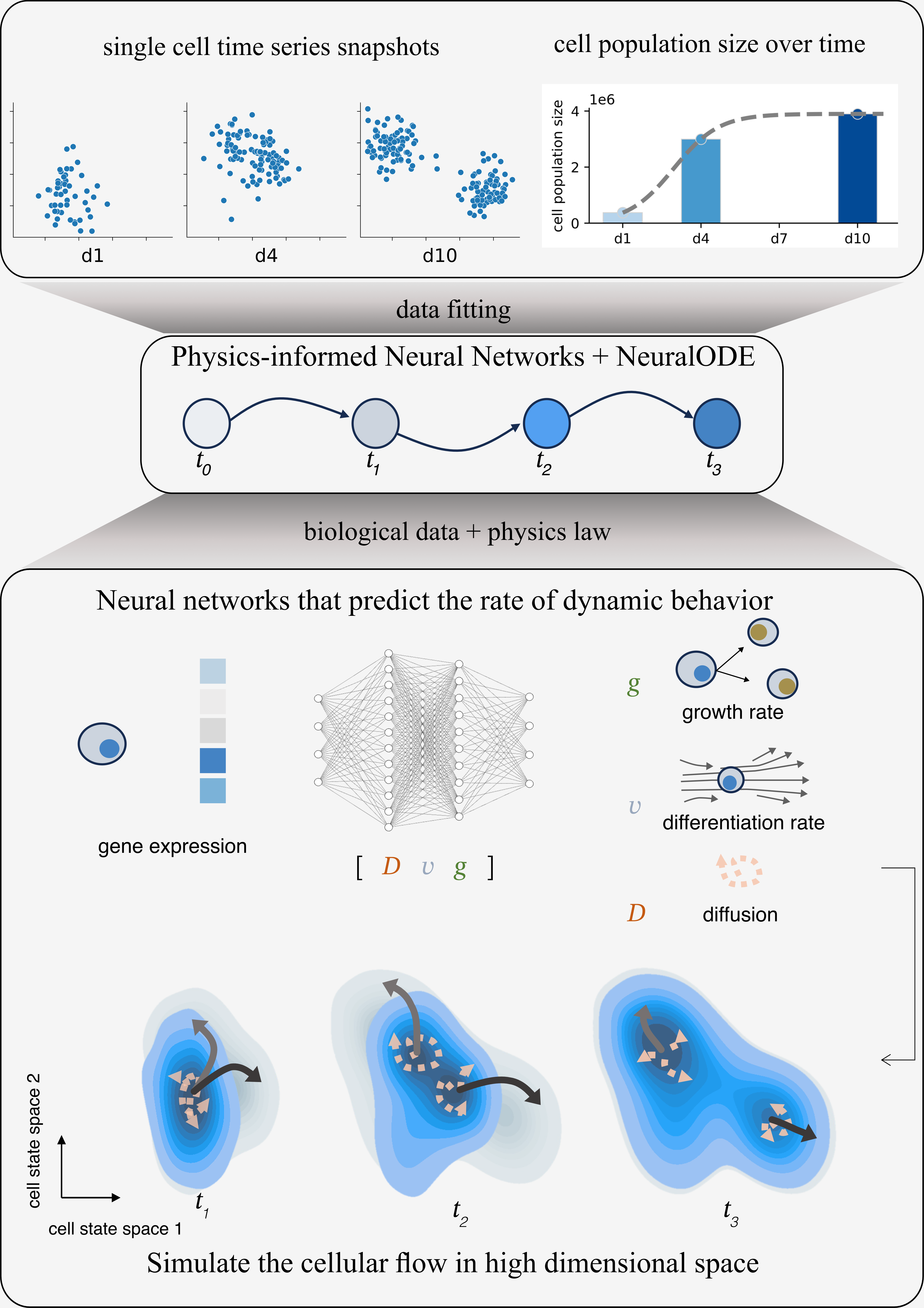
pseudodynamics+ is a computational framework for reconstructing population-aware cell state dynamics from time-resolved single-cell data. It is designed to bridge the gap between static single-cell snapshots and tissue-scale population dynamics by jointly modelling cell state transitions and changes in total population size.
At its core, pseudodynamics+ formulates cellular differentiation as a continuous density evolution process governed by a partial differential equation (PDE) that integrates three fundamental dynamic behaviours: proliferation (growth), directed state transitions (differentiation), and stochastic dispersion (diffusion).
To solve this high-dimensional PDE without discretising the cell state space, pseudodynamics+ leverages physics-informed neural networks (PINNs), enabling scalable and mesh-free inference directly in low-dimensional representations of single-cell landscapes.
Downstream analyses
By integrating single-cell transcriptomic time series with independent measurements of population size, pseudodynamics+ infers state- and time-resolved dynamic parameters at single-cell resolution. These parameters provide a quantitative description of how cells proliferate, differentiate, and redistribute across complex, branching developmental landscapes.
pseudodynamics+ enables a range of downstream analyses, including:
Estimation of growth, differentiation velocity fields, and diffusion across cell states
Reconstruction and interpolation of continuous cell density landscapes at unobserved time points
Simulation of cell state trajectories and future population dynamics
Quantification of continuous density transport between progenitor and descendant states
Identification of genes associated with dynamic changes in differentiation behaviour

Overall, pseudodynamics+ provides a population-aware, mechanistic framework for interpreting time-series single-cell data, offering insights into tissue development, homeostasis, and lineage bias that are not accessible from cell state information alone. It is applicable to complex multi-lineage systems and is particularly suited for studies where both molecular resolution and quantitative population dynamics are essential.