4. Continuous Density Transport Analysis
In this section, we will delve into the details of continuous density transport analysis. This analysis uniquely integrates the three learned parameters of the PDE and simulate the process a cell destribution its cell mass to its progenies.
This notebook includes:
simulating cell state transition trajectory
conducting continuous density transport analysis
visulizing the transportation matrix
visulizing the redistributed density with sankey diagram
%load_ext autoreload
%autoreload 2

import os, sys
if sys.platform.startswith("darwin"):
    os.environ['KMP_DUPLICATE_LIB_OK']='True'

import numpy as np
import pandas as pd
import matplotlib.pyplot as plt

import scanpy as sc
sc.settings.set_figure_params(frameon=False, dpi=30)

import pseudodynamics as pdp
os.chdir(pdp.main_dir)
print("workding directory changed to:", pdp.main_dir)
workding directory changed to: /rds/user/wz369/hpc-work/pseudodynamics_plus
Exp configs
We provide a simple example of how to use the functions in the package. Again, both the model and the data are resumed from the provided config file.
# find all config files
config_dir = "logs/ery_mk_Aug1_multiscaled_n6/pde_params_tsense"
configs = [file for file in os.listdir(config_dir) if file.endswith('.json')]
Reload experimental config and the model
config = pdp.ExperimentConfig(os.path.abspath(os.path.join(config_dir, 'V2_config.json')))
config.from_json(os.path.abspath(os.path.join(config_dir, 'V2_config.json')))


ckpt = config.find_lastest_ckpt()
pde_model = pdp.models.pde_params.load_from_checkpoint(ckpt, map_location='cpu')

result_dir = config.experiment_config['save_dir'].replace("logs", "results")
result_dir = result_dir + f"_2"
config.result_dir = result_dir
pdp.tl.make_dir(result_dir)
Tissue flow of megakaryocyte and erythrocyte differentiation
Here in this notebook we will simulate the tissue flow of megakaryocyte and erythrocyte differentiation. A ideal and simple branching system that can demonstrate the continuous density transport.
# # load dataset
dataset_name = config.experiment_config['dataset']
print(dataset_name)
adata = sc.read_h5ad(f'data/{dataset_name}.h5ad')

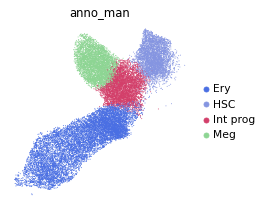
sc.pl.umap(adata, color='anno_man')
# create the pseudydynamics+ datamodule
ds_config = config.dataset_config.copy()
timepoint_idx = ds_config['timepoint_idx'].copy()
ds_config['timepoint_idx'] = None
ds_config['knn_volume'] = eval(config.raw_args['knn_volume'])

full_DS = pdp.reader.TwoTimpepoint_AnnDS(adata,split=None,**ds_config)
cellstate_key = config.dataset_config['cellstate_key']
====================
Dataset : Computing density :
	 `density_funs` not specified, default estimator gaussian kde
Dataset : all cells are used
simulate trajectory for HSC
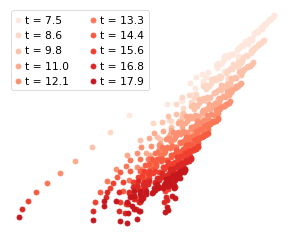
The learned drift term (differentiation rate) captures the next moment chagnes of cell state values in every dimension. This can be used to simulate the trajectory of cell state values. Here we start from the HSC and
# go for all HSC cells
import torch
import gc
import torch.nn.functional as F
from pseudodynamics.models import Density_Transfer
from tqdm.auto import tqdm
# Density Transfer Class wrapping the PDE model
DT = Density_Transfer(pde_model)
# prepare the initial cell states
HSC_ad = adata[adata.obs['anno_man']=='HSC'].copy()
s0 = HSC_ad.obsm['DM_EigenVectors_multiscaled']
s0 = torch.from_numpy(s0).float()

# the simulating time window, let say day 12 to day 49
integrate_time = np.linspace(12, 49 , 11) / pde_model.time_scale_factor
S_trajectory = DT.cellstate_drift(s0, integrate_time)
print(S_trajectory.shape)
(10, 67, 3)
The simualted trajectory records the intermediate states of the cell state transition process.
color_fn = lambda x : plt.colormaps.get_cmap('Reds')((x+1)/13)

fig = plt.figure(figsize=(6,5))
ax = fig.add_subplot(111)
ax.axis("off")

for step in range(S_trajectory.shape[0]): # the number of time steps

    ax.scatter(S_trajectory[step,:,0], S_trajectory[step,:,1],
                color = color_fn(step),
                label = f't = {integrate_time[step]:.1f}'
                )
    ax.legend(ncol=2)
Dynamic density transport
n_interval = 10
n_cell = 300
celltype_key = 'anno_man'
start_celltype = 'HSC'
device = 'cpu'
save_name = 'ery_mk_density_transport'
Instanize the DensityTransport class with pde model
result_dir = config.result_dir
pdp.tl.make_dir(os.path.join(result_dir, save_name))

# timepoint key
selected_time = [ 3,   7,  12,  27,  49, 112, 269]

timepoint_key = 'timepoint_tx_days'
t0 = selected_time[0]
scaling_factor = pde_model.time_scale_factor
pdp.tl.make_dir(os.path.join(result_dir, save_name))
HSC_cbs = []


for it,t in tqdm(enumerate(selected_time[:-1])):

    # CHANGE HERE to adjust the integration time according to how the time is normalized
    t1 = t - t0
    t2 = selected_time[it+1] - t0
    integrate_time = np.linspace(t1, t2 ,n_interval+1) / pde_model.time_scale_factor

    # print out the integration time
    print(np.round(integrate_time, 2))

    # find cell of time
    start_cell = adata.obs.query(f"`{celltype_key}` == @start_celltype & `{timepoint_key}` == @t").index
    start_cell = list(start_cell)
    HSC_cbs.append(start_cell)

    # define initital density and cellstates
    cell_index = [np.where(adata.obs_names == x)[0].item() for x in start_cell]
    u0 = full_DS.u_b[it, cell_index].float().to(device)
    s0 = torch.from_numpy(full_DS.cellstate[cell_index]).float().to(device)

    # density transport here
    S_trajectory = DT.cellstate_drift(s0, integrate_time)
    Tmaps_t, Tmaps_t_norm = DT.transition_by_batch(s0, u0,integrate_time,
                                                    n_interval=n_interval,
                                                    ncell=n_cell)

    del u0, s0


    print(f"results saved to {result_dir}")
    endtime = np.round(integrate_time, 2)[-1]
    np.save(os.path.join(result_dir, save_name, f"{start_celltype}_Day{t1}-{t2}_sim_trajectory.npy"), S_trajectory)
    np.save(os.path.join(result_dir, save_name, f"{start_celltype}_Day{t1}-{t2}_TransportMap.npy"), Tmaps_t)
    np.save(os.path.join(result_dir, save_name, f"{start_celltype}_Day{t1}-{t2}_Norm_TransportMap.npy"), Tmaps_t_norm)
    np.save(os.path.join(result_dir, save_name, f"{start_celltype}_Day{t1}-{t2}_cellbarcode.npy"), start_cell)
[0.  0.4 0.8 1.2 1.6 2.  2.4 2.8 3.2 3.6 4. ]
results saved to /rds/user/wz369/hpc-work/pseudodynamics_plus/results/ery_mk_Aug1_multiscaled_n6/pde_params_tsense_2
[4.  4.5 5.  5.5 6.  6.5 7.  7.5 8.  8.5 9. ]
results saved to /rds/user/wz369/hpc-work/pseudodynamics_plus/results/ery_mk_Aug1_multiscaled_n6/pde_params_tsense_2
[ 9.  10.5 12.  13.5 15.  16.5 18.  19.5 21.  22.5 24. ]
results saved to /rds/user/wz369/hpc-work/pseudodynamics_plus/results/ery_mk_Aug1_multiscaled_n6/pde_params_tsense_2
[24.  26.2 28.4 30.6 32.8 35.  37.2 39.4 41.6 43.8 46. ]
results saved to /rds/user/wz369/hpc-work/pseudodynamics_plus/results/ery_mk_Aug1_multiscaled_n6/pde_params_tsense_2
[ 46.   52.3  58.6  64.9  71.2  77.5  83.8  90.1  96.4 102.7 109. ]
results saved to /rds/user/wz369/hpc-work/pseudodynamics_plus/results/ery_mk_Aug1_multiscaled_n6/pde_params_tsense_2
[109.  124.7 140.4 156.1 171.8 187.5 203.2 218.9 234.6 250.3 266. ]
results saved to /rds/user/wz369/hpc-work/pseudodynamics_plus/results/ery_mk_Aug1_multiscaled_n6/pde_params_tsense_2
Analysing the density transport result
# load the DT results
DTA = pdp.models.DT_analysis(adata, result_dir=os.path.join(result_dir, save_name), celltype=start_celltype)

# annotate the celltype for simulated data point
celltype_trajectory = DTA.annotate_trajectory('DM_EigenVectors_multiscaled', obs_key='anno_man', copy=False)
24-46 (11, 386, 3)
46-109 (11, 281, 3)
4-9 (11, 130, 3)
0-4 (11, 105, 3)
9-24 (11, 67, 3)
109-266 (11, 704, 3)
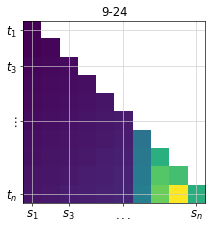
visualizing the tranpsport matrix
time_span = '9-24'

ax = DTA.vis_Tmap(DTA.TM_dict[time_span][3])
ax.set_title(time_span)
Text(0.5, 1.0, '9-24')
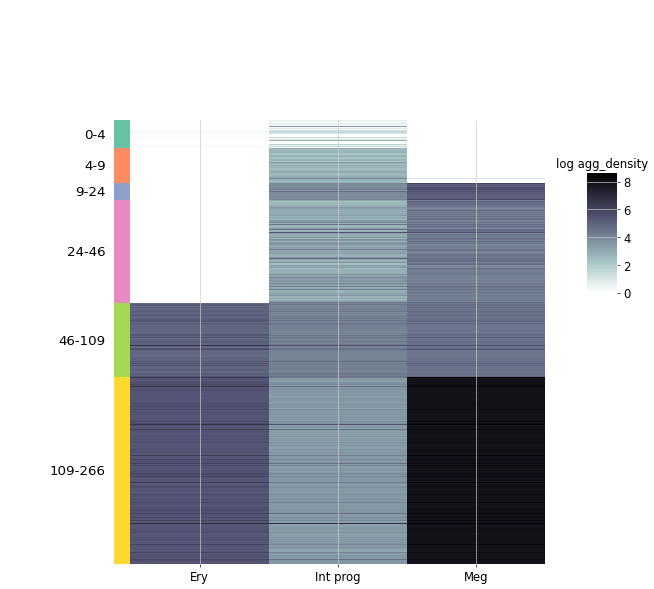
visualizing the cell type redistribution
DTA.density_by_celltype_step(celltypes=['Ery', 'Int prog', 'Meg'], step=-1, norm=True)
g = DTA.heatmap_cell_proportions(
                                ['Ery', 'Int prog', 'Meg'],
                                value='agg_density',
                                step=-2,
                                log_normalize = True,
                                    cbar_pos=[0.99, 0.5, 0.05,0.2],
                                    cmap='bone_r'
                                     )
Sankey plot for tissue level flow
celltypes = ["Ery",  "Meg", "Int prog"]
first_step= DTA.density_by_celltype_step(celltypes=celltypes, step=0, norm=False)
last_step= DTA.density_by_celltype_step(celltypes=celltypes, step=-1, norm=False)


first_step_sum = first_step.groupby('Day').agg("mean").reset_index()
first_step_sum['step'] = 1
first_step_sum.rename({'Int prog':"MEP"}, axis=1, inplace=True)
first_step_sum = first_step_sum.set_index("Day").rename({'Int prog':"MEP"},axis=1)

last_step_sum = last_step.groupby('Day').agg("mean").reset_index()
last_step_sum['step'] = 10
last_step_sum = last_step_sum.set_index("Day").rename({'Int prog':"MEP"},axis=1)

first_step_sum
| Ery | Meg | MEP | step | |
|---|---|---|---|---|
| Day | ||||
| 0-4 | 0.000000 | 0.000000e+00 | 4.035307e-07 | 1 |
| 109-266 | 0.000002 | 9.566587e-03 | 1.072948e-05 | 1 |
| 24-46 | 0.000000 | 3.130689e-06 | 1.040727e-04 | 1 |
| 4-9 | 0.000000 | 0.000000e+00 | 1.541898e-06 | 1 |
| 46-109 | 0.000000 | 1.909346e-04 | 1.470297e-03 | 1 |
| 9-24 | 0.000000 | 1.205958e-07 | 7.007235e-05 | 1 |
visualize sankey plot
!pip install plotly
!pip install Kaleido
import pandas as pd
import plotly.graph_objects as go
timeponts = ['0-4', '4-9', '9-24', '24-46', '46-109']
celltypes = ["MEP", "Ery",  "Meg"]

label = []
for i, time in enumerate(adata.uns['pop']['t'][:6]):
    for s, source_cell in enumerate(celltypes):
        label.append(f'{source_cell} D{time}')

color = ['#7f7f7f', '#8C554A',  '#AFC7E5'] * 6

source = []
target = []
value = []
for i, time in enumerate(timeponts):
    for t, target_cell in enumerate(celltypes):
        for s, source_cell in enumerate(celltypes):


            source.append(i*3 + s)
            target.append((i+1)*3 + t)

            if source_cell == 'MEP':
                prop = last_step_sum.loc[time, target_cell].item() / last_step_sum.loc[time, celltypes].sum().item()
                flow = last_step_sum.loc[time][target_cell] - first_step_sum.loc[time][source_cell] * prop
                # flow = first_step_sum.loc[time][target_cell] * prop #- first_step_sum.loc[time][source_cell] * prop
                value.append(flow)

            elif source_cell == target_cell:
                value.append(1e-20)

            else:
                value.append(0)
flow_df = pd.DataFrame(
    np.array([source, target, value]).T,
    columns=['source', 'target', 'value']
)

y_loc = []
x_loc = []
for i in range(6):
    pad = (i + 1)* 0.1
    y_loc.extend(
        [0.6-np.random.random()*0.1, 0.6-pad, 0.6+pad]
    )
    x_loc.extend(
        [i*0.2, i*0.2, i*0.2]
    )
fig = go.Figure(data=[go.Sankey(
    node = dict(
      pad = 20,
      thickness = 20,
      line = dict(color = "black", width = 0.5),
      label = label,
      color = color,
      x = x_loc,
      y = y_loc,

    ),
    link = dict(
      source = source, # indices correspond to labels, eg A1, A2, A1, B1, ...
      target = target,
      value = value
  ))])

fig.update_layout(font_size=16)
fig.show()
fig.write_image(os.path.join(result_dir, 'unnormalized_sankey.svg'))